WDoR2023
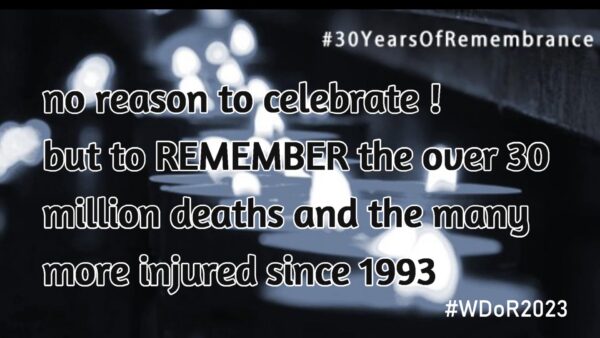
This year it will be 30 years since the idea of a Remembrance Day was born in London.
Brigitte Chaudhry proposed to remember every third sunday in November the Road Traffic Victims.
But is there really a reason to celebrate ?
On this page you will be updated on information relevant to our fast approaching World Day – please check in regularly.
This year it will be 30 years since the idea of a Remembrance Day was born in London.
Brigitte Chaudhry proposed to remember every third sunday in November the Road Traffic Victims.
But is there really a reason to celebrate ?
Today we honour all Women Campaigners for Worldwide Peace on the Roads
Road danger inflicts intolerable pain and suffering
Road danger inflicts unacceptable restrictions on everyday activities
Today, on International Women’s Day, we remember the millions of women killed, injured and bereaved as the result of road crashes – mothers, wives, sisters, grandmothers, daughters, aunts, cousins, friends, colleagues and neighbours.
We mourn for them, whose lives have been cruelly cut short by acts that could and should have been prevented.
We empathise with the women who became widows, single mothers, orphans, singletons and childless, with all who have suffered loss, pain and injustice.
Today we also pay tribute to all women around the world who became campaigners against this cruel and senseless loss of life and health and its casual acceptance. Many women, often victims themselves, have worked tirelessly for the past decades, setting up organizations, NGOs, whose aim is to achieve
* acknowledgement of the true scale as well as cost of this disaster, in order to end it * justice for road traffic victims, who are the most neglected victims of all, and * roads that are safe to use by all road users, especially the vulnerable – children, elderly and disabled.
The World Health Organization has described road death and injury as a major public health crisis and is calling for greater efforts to help turn the tide of the huge numbers of road deaths and injuries throughout the world.
Campaigning for Worldwide Peace on the Roads –
The World Day of Remembrance Foundation proposes this hashtag -#womenforpeaceontheroadcampaigners – as a platform for quotes on Why I campaign from women who are champions of road victims and road danger reduction – the mothers, wives, sisters, partners from all the countries in the world who we are honouring today. These statements would provide valuable insights, therefore follow us on Social Media and please share your reasons for campaigning there.
Here is one example from the UK:
“I campaign because everyone should have the right to the healthcare treatment they require. My husband and I were both seriously injured by a woman driving under the influence of drugs. My husband survived for 11 days, being driven in a deteriorating condition between a specialist unit and a local hospital without facilities for head injury. I am left permanently disabled. I campaign because my injuries were not even taken into account since there is no charge of ‘Causing injury by dangerous driving’. I campaign because of the overwhelming financial burden on our police, ambulance, fire, healthcare and legal systems. Mostly I campaign to try and make sure other people do not have to go through the hardship and heartbreak I have had to.”

Road traffic injures are a leading cause of death and disability worldwide, with around 1.3 million people killed and as many as 50 million people injured each year. For people aged 5-29 years, there is no greater threat to their lives. Globally, 1 of every 4 deaths occur among pedestrians and cyclists.
The Global Plan for the Decade of Action for Road Safety 2021-2030 reflects an ambitious target to reduce road traffic deaths and injuries by 50% by 2030. It highlights that they can be prevented by addressing the whole of the transport system, taking action to ensure safe roads, vehicles and behaviours as well as to improve emergency care.
WHO, in collaboration with partners, organizes periodic UN Global Road Safety Weeks. This 7th edition focuses on sustainable transport, in particular the need to shift to walking, cycling and using public transport. Road safety is both a prerequisite for and an outcome of this shift.
WHO invites all road safety and sustainable mobility partners to mark the 7th UN Global Road Safety Week. More details here
Campaign materials are available here
Through religious services, lighting candles, inaugurations of memorials and other types of public advocacy and online events, the World Day of Remembrance is the occasion to remember those who have lost their lives or who have been seriously injured on the world’s roads. It also provides an opportunity to draw attention to the need for improved justice for victims. On World Day we too pay tribute to the dedicated emergency crews, police and medical professionals, who deal daily with the traumatic aftermath of road crashes.
Wherever you are, we look forward to your participation throughout the world commemorating the World Day of Remembrance for Road Traffic Victims. Your contribution will represent a lasting memorial to all those killed and injured and to the courage, endurance and generosity of victims, survivors and affected families.
World Day of Remembrance for Road Traffic Victims Foundation Team wishes you a memorable Remembrance Day! Thank you!
In the last moments before this year’s WDoR, we look at some of the many events happening all over the world.
India has events in the cities of Gujrat, Jaipur, Mumbai, Udaipur, Surat, Patna, Gurugram, Kozhikode, Vadakkencherry, Ahmedabad and more.
Mexico City and Merida are the participating cities from Mexico.
In the USA, participating in WDoR are Los Angeles, Louisville, Montgomery County, Manatee County, Delaware, Orlando, Treasure Island city hall and Williams park, and even online.
More participating countries include Trinidad and Tobago, Pakistan, Chile, Russia, Norway, Argentina, Canada, Bulgaria, New Zealand and Namibia, among those too many to list.
A full list of events can be found on our website as we enter the World Day of Remembrance.
Remember, Support, Act.
Victoria is on the board for the World Day of Remembrance Foundation. She has written a blog in support for this year’s theme for WDoR.
Almost eight years ago I was cycling to work when the driver of a skip lorry turned left across my path and crushed me. I was very lucky to survive, but suffered life-changing injuries including having my left leg amputated. Following a very thorough police investigation, the cause of the crash was found to be that the driver had failed to look in his mirrors for thirteen seconds leading up to the collision.
The theme of justice for this year’s World Day of Remembrance is fitting as so often victims do not feel they received justice.
In my case, the driver was charged with ‘Causing serious injury by dangerous driving’, which carries a five year maximum sentence. The charge was then downgraded to simply ‘careless driving’, as it was agreed that the driver would plead guilty to this charge. Whilst we have a separate charge for causing death by careless driving, at the time ‘causing serious injury by careless driving’ did not exist. This meant the only sentence available was a few penalty points and a fine, as the charge is fit only for minor driving misdemeanours. In fact at the time of sentencing, the driver’s barrister argued successfully that he should only receive six penalty points, as any more would render it almost impossible for him to find work as an HGV driver (!).
People are often shocked when I explain the justice outcome of my case. A £750 fine and six penalty points seem insulting and wildly disproportionate to the injuries I have suffered. How can someone who has inflicted so much suffering be allowed to continue with their life and their work? Legislation was this year updated though, with a new charge of ‘Causing serious injury by careless driving’ being consulted on by the Sentencing Council. The new charge carries a maximum custodial sentence of two years.
It is not however my personal belief that careless driving, even when it results in death and injury, warrants prison time. Carelessness is often a momentary lapse in concentration, and the seriousness of the outcome is a result of luck and many other factors that are outside of the perpetrators control. Depending on the age and health of the victim, the speed limit of the road, and where the force hits the victims’ body all play a role in the seriousness of the outcome. Whilst careless driving (which causes slight injury or no injury at all) is punishable with a few points, the outcome of serious injury now has a two year maximum custodial sentence, and five years if the outcome is death. The UK has also adopted a ‘safe systems’ approach to its road safety policy, and underpinning this strategy is the concept that transport systems should allow for human error without these errors resulting in death and injury. Criminal, reckless driving behaviour is not human error, but I would say that many ‘careless’ driving behaviours are ultimately just human error. Should we therefore be sending people to prison for outcomes we purport our transport system should protect people against?
Arriving at ‘justice’ for road crime is more difficult I think than other crimes, as the intent to cause harm is often not there, but the outcomes are so serious. The culpability of the defendant is often at odds with the suffering of the victims, and it presents a challenge for us to settle on what is ‘justice’. It is easy I think to just see justice in terms of prison sentences, but I don’t believe longer prison sentences are necessarily appropriate for the level of culpability, nor do they act as a deterrent to drivers to improve their driving behaviour.
Justice for victims should
It is my sense that we are currently not doing very well on these three criteria. Victims frequently feel let down by the justice system, and dangerous driving behaviour is still widely accepted by society as not being criminal. Speeding is socially accepted, despite it being found to be a factor in 50% of fatal crashes in London.
Prison is appropriate where culpability is significant and the driver is knowingly driving in a way that is putting others at risk, for example with drink or drugs or driving in a dangerous manner. However a large proportion of cases which result in death and injury are not caused by this level of culpability, they are caused by momentary lapses of concentration, and I do not think the criminal justice system currently is serving victims, perpetrators or society for these crimes.
Whilst I do not have all of the answers, there are two areas which I feel would go a long way to remedying the three criteria of justice:
Victims frequently report that they feel their crash was not investigated properly. Whilst this is true of some bereaved families, it is more frequent amongst seriously injured victims, who in most cases will not have their crash investigated by a specialist Serious Collisions Investigation Unit, and will not have a forensic collision investigator. It has been reported to me that even when injuries are very serious, limited evidence is gathered (no CCTV, few witness statements etc). The impact of this is significant. Not only does this render it impossible to secure a criminal conviction, it also impacts significantly on victims being able to access financial support to help them cope and recover from their injuries. We have a fault-based civil compensation system in the UK, and lack of evidence means it is difficult to prove liability and therefore prove a victim is entitled to funds to help rehabilitate them. Ensuring more thorough investigations, with standards set, would not only improve criminal justice outcomes but also mitigate a lot of suffering that seriously injured people endure.
Driving bans are the punishment that truly fit the crime. Whilst as I have outlined earlier some criminal driving offences deserve prison, there are many that do not. Driving bans not only punish, they also remove the risk that the driver poses to society. A recent analysis by campaign group Action Vision Zero found that although lifetime bans have increased for more serious dangerous driving charges, only a very small proportion of less serious charges such as careless driving and speeding resulted in a ban, with wide variation across the country. Increasing the number and length of bans would not only protect society, it would also deliver justice in cases where a person has been injured. Whilst I don’t know of any research undertaken to date of the deterrence factor of driving bans, I strongly suspect it would be significant, thus improving driving behaviour across society.
I did not want the lorry driver who injured me to go to prison, but it would have been fitting I think for him to receive a driving ban. I hope that this year’s World Day of Remembrance theme prompts decision makers to look beyond prison and think more creatively and practically as to how the criminal justice system can deliver justice for victims and address the driving culture we currently have.
Countries all around the world are participating in the WDoR initiative with many different events. On the WDoR website, one can find details about initiatives like ASR’s meeting and press release in Tunisia, Ethiopia’s full month of planned events, the Australian social media campaign by ARSF, Panama’s religious service dedicated to WDoR, the Moldovan road safety training for university students, and many more.
In Kenya, events are planned at several locations: an awareness walk, tree planting and school zone launch in Mombasa, fundraiser tree planting in the Ngong Road Forest Sanctuary, a road show in Nakuru and even an online streamed candlelight memorial
Greece has a voluntary blood donation day, a memorial will be unveiled in Bogota, Colombia and road safety leaflets will be distributed in Sarajevo, Bosnia and Herzegovina.
The OSEV (Organizaciones Ciudadanas pr la Seguridad Vial) Organizations in Chile have organized markings of WDoR in Antofagasta, Inquique, Lanco, Lota and more.
These events and many more make WDoR a true worldwide phenomenon, urging people everywhere to Remember, Support and Act for road safety.
The Safe Way Right Way organization, along with multiple partners, has prepared the training of 120 riders in Kawangware “on road safety, First Aid, SGBV, insurance and correct use of PPEs” between the 21st November and 2nd December. Sessions with motorcycle crash victims and a Q&A with traffic police are also planned to bring awareness to the issue of road accidents. More details on SWRW’s program on the event page.
This year, the date before the official marking of WDoR is also one full of events:
A commemoration ceremony is organized in Luxembourg by the National Association of Road Victims. Access is open for anyone who wishes to remember and support those affected at the “Lieu du Souvenir”. The program and address are available here.
The Mentor And Mentee African initiative (MAMA) is holding a Road Safety Awareness Walk this Saturday, which will be followed by a conference and award ceremony on the 20th. Traffic officers will be rewarded for their work and the lost and injured lives will be commemorated in Nigeria. Find more information here.
The Sierra Leone Road Safety Authority has been engaging for WDoR this last week, and their program does not end soon. On Saturday the 19th, they have planned a wreath laying in the morning. On this link, you may find their full diverse program spanning from Friday to Sunday.
In Bogor City, Indonesia, November 19 is fully planned, starting at 6:00 am with a series of testimonies from families affected by road traffic accidents. The national anthem will then be sang and prayers will be read, followed by a series of speeches and finally a distribution of prosthetic legs, wheelchairs and canes for physical support to those affected. Details here.
The Save the Nation Road Safety Program from Ethiopia has planned a visit to victims of road traffic accidents in two hospitals. Their goal is to sensibilize and bring awareness to workers of commercial transport associations. Open the event here.
At midday, the Driver Academy of Curacao will be contacting media and the government to send a ribbon and article related to the World Day of Remembrance. Find more information here.
The Traffic Safety Council Of Zimbabwe is organizing a march in Bulawayo on the 19 November to commemorate road accident victims and note the World Day of Remembrance 2022. Event link here.
In Algeria, the 19th of November is the opening date of a road safety club by the Road Safety Association Tizi-Ouzou. The club is named Ixulaf Decade 2021/2030. Find the address and more information here.
The Minsitry of Transport and Public Works of Botswana will be hosting a workshop this Saturday around the theme of ‘Justice’, giving road traffic victims a platform to share their experiences – here is the link to the event.
Finally, Minnesota will have its 3rd annual recognition of WDoR in the afternoon of November 19 – “Honoring people killed on Minnesota roads in 2022. Remember, Support, Act”. Find out more here.
The Croatian organization Udruga Sigurnost u prometu held, earlier today (16 november), an expert round table along with the Faculty of Traffic Sciences and with the cooperation of the Ministry of Internal Affairs and Center for vehicles. The discussion was aimed towards increasing road traffic safety within the country. Event information here.
For the 20 November, they have planned a laying of wreaths at Zagreb’s city cemetery, followed by a Holy Mass for road traffic victims. The organization calls to Croatian citizens to light candles and display them at windows for the World Day of Remembrance. Read more.